
News
Introducing Waveform Visualisation in The Noise App Audio Player
Introducing Waveform Visualisation in The Noise App Audio Player
News
We’re excited to introduce a new enhancement to The Noise App’s audio player: a waveform display that visually represents the audio captured in each recording. This update is the first step in a broader set of improvements to how officers review and interpret sound evidence, with further developments planned in upcoming releases, particularly around sound classification.
Officers investigating noise complaints often need to review multiple recordings captured throughout the day, each typically 30 to 90 seconds long. Prior to this advancement, assessing these recordings meant listening to each one in full to determine whether it contained potentially actionable noise.
The new waveform display changes that.
With this visualisation, officers can quickly see where noise levels rise and fall within a recording. Taller peaks in the waveform represent higher noise levels, while smaller peaks indicate quieter moments. This makes it much easier to identify:
Where the loudest noise occurs
When quieter periods appear
Whether noise is continuous or intermittent
Patterns that may emerge across days, weeks or months of recordings.
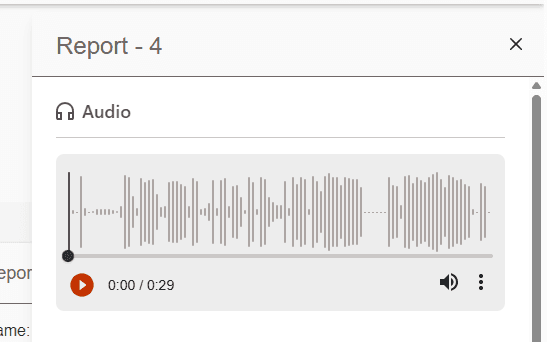
For example, a waveform from a 29-second recording such as the one above might show an initial quiet section before the noise becomes consistently loud. Around the 20-second mark, the waveform drops to a lull before rising again as the volume increases.
Officers can move the cursor along the timeline to jump directly to a specific point in the recording, allowing them to focus on sections of interest immediately, without having to listen to the entire file.
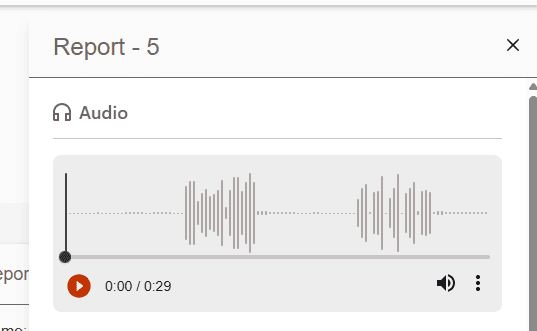
By contrast, a recording with generally lower noise levels but intermittent loud periods will produce a waveform such as the one above, visually distinguishing it from recordings containing sustained loud disturbances.
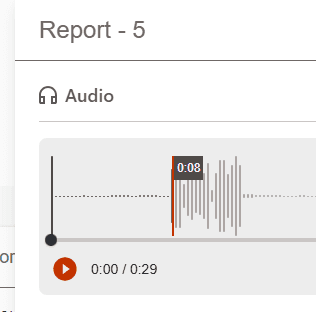
Officers can also hover over sections of the waveform to pinpoint when the noise begins.
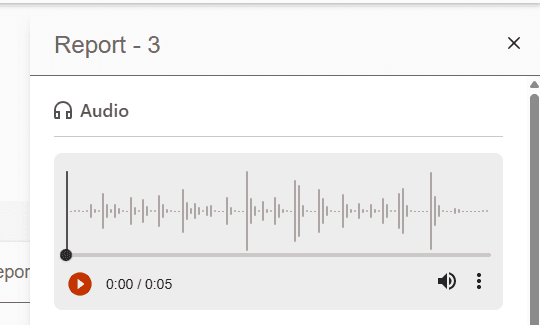
This visual representation provides a much clearer picture of the noise in question and allows for quick identification of whether it is high in volume and sustained over time.
To support this feature and future enhancements, we rebuilt the audio player from scratch. This new foundation provides a more flexible architecture, making it easier to introduce updates and expand functionality in future releases.
This waveform display is just the beginning. With the new audio player in place, we’re now well-positioned to expand the platform’s audio capabilities, particularly in advanced sound classification and analysis.
As we continue developing these tools, our goal remains the same: helping officers review evidence more efficiently, more accurately and with greater clarity.